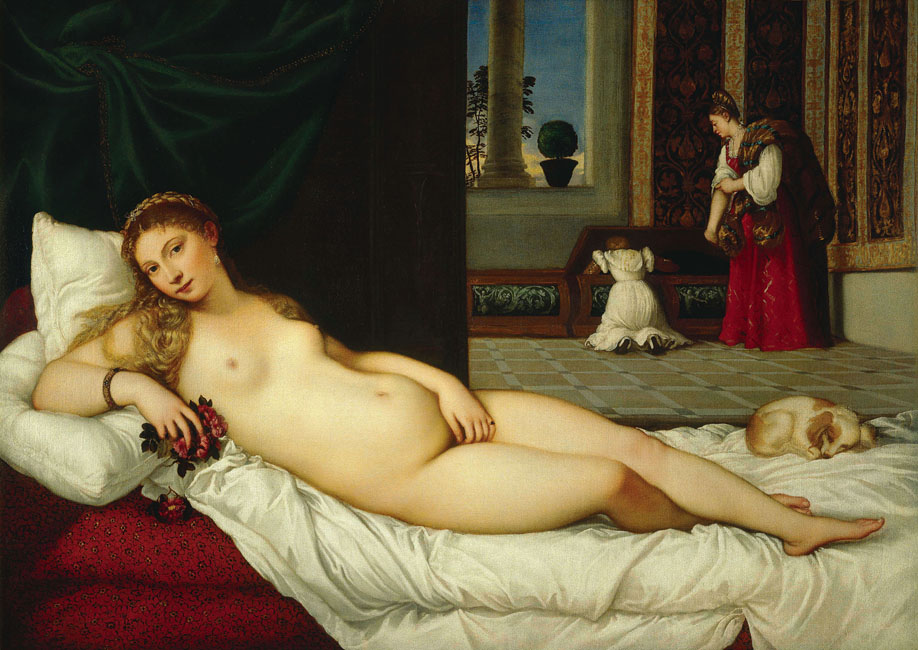
Titian - Venus of Urbino
"He is the Subject, he is the Absolute - she is the Other" - Simone de Beauvoir
When my oldest daughter was 3 turning 4, I remember her grandmother, my mother in law, whom I adore, asking me if she would like a Barbie for her birthday. I was brave enough to say, "No, I don't think I really want her to play with Barbies because of what they teach girls about how the female body can be objectified." Two weeks later, after having sent invitations to all the little girls in her preschool class, for a ballerina themed party no less (irony?), one mother approached me at the preschool all excited, and whispered, "I found the perfect gift! A ballerina Barbie!" This time however, I wasn't strong enough. I said something like "Oh, that's great!" Inside I felt like a liar and hypocrite - I'm not really a feminist after all. (It was only years later after having internalized Sarah Blafer Hrdy's Mother Nature, that I realized I was just trying to establish a new allo-mother relationship by compromising my ideals, the perfect feminist situation - women are forced to compromise. Whereas with my mother in law, the allo-mother relationship was already strong, and showing my disapproval about a Barbie wouldn't harm that bond.) So, the little girl gave my daughter a Barbie, and the world did not end. My daughter never really liked playing with that Barbie or subsequent Barbies, but I always felt like I lacked true feminist integrity.
What's worse is that I realize from time to time that I often throw feminism out the window for other more explicitly male-driven values. For example, every day I experience the pangs of "bad faith" when I get dressed. I prefer to wear make-up, and joke that I can't leave the house without mascara and lipstick - I know this is a cliche, but I've been known to say it. I also prefer to wear tighter fitting, hopefully flattering clothes, because it makes me feel more attractive. And I'm aware that we as women sometimes say that we dress-up for other women, not for men. I know I dress up for the all female book club or get together, but I can't say that I put lipstick on before going in to the grocery store just for the other women in there. (N.B.: Before this goes too far, I do love my husband and am not in the pursuit of another man, consciously.) I've also been known to rationalise this behavior by saying that it's about self-respect - I think I look better with make-up, and if you're not trying to look your best then you must not think very highly of yourself...Oh this is difficult to write because I am uncomfortable that I even think this way! And this discomfort is the crux of the problem .
As a feminist I want to change society so that women and girls can be self-determinists. This means that we can chart our own courses, make choices without the influence of male dominance, patriarchy or objectification. In order for this to happen the female experience has to be legitimized, and in turn objectifying forces need to be purged from our growing-up experience. (A great overview of this philosophical scholarship by Diana Meyers can be found at http:/plato.stanford.edu/entries/feminism-self/ - I highly recommend reading it!) Simone de Beauvoir argued that we as women learn growing up in a male-dominated world to objectify ourselves. Feminists Sandra Bartky and Susan Babbitt also argue that we as women learn to subvert our own desires and goals because we have been conditioned through patriarchal norms to become more gender-compliant. I find both of these ideas compelling because they correspond with my own experiences (i.e. why did I argue with my history teacher so vociferously for something that was antithetical to my everyday experience if it wasn't for the force of patriarchal norms affecting me while I was trying to figure out the world and my place in it?) The issue here is that androcentric (male) values affect us at such a young age that they change who we could be.
Perhaps my love of clothes and make-up, and acknowledgment of (acceptance of, desire for?) the possible sexual power they may enable me to have in society, is all the product of androcentric influences. What troubles me is that I have no desire to rid myself of these crutches/tools. In fact, as I get older I seem to be using more make-up, dressing up more frequently as I scrutinize the image in the mirror. I recognize that in the process of choosing clothes and applying make-up I am objectifying myself - I am making myself an object. Does this mean that I am renouncing my subject self, the self that has autonomy, choice, and freedom? Or does it mean that I am only loping off 10% of my subject self? How much make-up, clothes, plastic surgery!, would I need to use to get to a tipping point, where I have a minority stake in my self? And most frightening, what am I indoctrinating my daughters with (without their consent mind you) when I show how much I value my object self?
As before I would love to read your ideas on this subject. Perhaps you can answer some of the questions above.

What an interesting post, especially coming from my friend who competed in high school speech with the topic that the glass ceiling does not exist :)
ReplyDeleteMy girls are younger, but what fascinates me is where they learn behaviors related to outward appearances. I rarely wear makeup (funny -- I have to mention remembering you putting on lipstick prior to cross country practices. Something that to this day makes me laugh). The other women who play a role in my girls' lives also wear little to no makeup. Yet, my 2 oldest (who are almost 6 and 3) love putting makeup on. Having no boys, I cannot say if boys in the same environment would be interested in makeup but my guess is no. Where does this idea come from? Is it merely an expression of self? Do I put too much pressure on my girls to be pretty, especially since I am constantly telling them how beautiful they are?
Sorry that I have no answers to your questions. I think having a strong sense and value of oneself is of the utmost importance. If that includes putting on makeup or wearing nice clothes, what is wrong with that? Now if makeup and nice clothes become a crutch that would prevent you from experiencing life (e.g. if you could not go to the ER because you don't have your makeup on), I would be concerned. Just some of my thoughts...
What if most of your self-objectification actions are actually reactions or acts of rebellion to your environment. I remember at the same time in your life when we lived in very liberal Minnesota, you reveled in Rush Limbaugh's radio program, where he made all kinds of fun of "liberals," feminists being a subcategory. Our mother did not wear make-up or dress up at the time, and you had huge self esteem issues. So all of these factors combined resulted in one young Rebekah, rebelling against the liberally political climate of Minnesota, by siding with Rush, and rebelling against Mom by wearing make up and reading Vogue magazine. In high school you also loved a certain power you had over guys who were attracted to you (the red lipstick factor). But don't forget wearing your hair in a bun with your grandma glasses and no make up to church or being excessively studious, and relishing the attention you got for "not caring," and being "intellectual."
ReplyDeleteI guess my point is that I don't think you objectify yourself. It's not like you post nude pictures of yourself online for attention.
On another note, do you think that no one (besides Grandpa)really cared about us choosing unprofitable majors because no one ever expected us to make money (becasue we are girls?)
I've thought about this and most of my potential comments were essentially justifications about why it is okay to "care" what you look like.
ReplyDelete1 - Our human nature means we respond to how things look. You can choose to ignore this fact, or to incorporate it into your reality.
2 - In terms of self worth - I agree with momsnelson's 3rd paragraph. How you look shouldn't define who you are.
3 - I like the idea that you should look at yourself in the mirror in the morning as you head out the door, then not think about it again the rest of the day. Your makeup shouldn't need constant reapplication and your clothes should be comfortable - how you look shouldn't interfere with your life. (Do what I say, not what I do. ;)
I think self-expression can be healthy, and it can be unhealthy. I've got young nieces (other side of the family) who won't leave the house without perfect hair and clothes. My girls wear... let's call it "interesting" clothing choices and hairstyles that they come up with all on their own... devil may care whether they match in the conventional sense. I hate to label either attitude toward outward appearances as healthy or unhealthy. They are just different.
ReplyDeleteI really do see it as "Beauty is in the eye of the beholder." I think hair, make-up, and clothing are just colors and shapes we add to our God-given canvasses. Some people like Renoir and some people like Picasso.
On another note, your "tipping point" comment is interesting. I've never loved my A-cup breasts or my nose, but would never, ever endure plastic surgery for either of them. They have been lifelong issues, and while they embarrass me, they also kind of define me, so I'm okay with them. Now, my knees are another story! My legs are something I've always been proud of, and how that gravity is really catching up to me and I've got that loose skin that hangs over my knees... a little nip/tuck doesn't seem like a horrible idea... No, I know there is no way I would spend the money on cosmetic knee surgery. I would rather take that money and go to Europe... but I don't dismiss the idea so quickly.
Oh, Rebekah! I'm so glad you started this blog. Any friend of Rebekah's is a friend of mine. I'm looking forward to many more thoughtful posts from you and your sister friends!
In response to your facebook questions:
ReplyDeleteIt seems like in all cultures women modify their appearances more than men do. What about the women in Africa who put rings around their necks in order to elongate them? I don't think changing our appearance is always objectifying ourselves or to please men, although attracting a mate is important for the self preservation of any species.
Oh, I wish I had something novel to add here. I have grappled with these same types of questions, both for myself and in terms of how we raise our kids. I suppose one helpful way for me to think about this is in the balance we place between an emphasis on outward appearance and character. To this end, there's a fascinating book called "The Body Project" written by historian Joan Brumberg, who explored diary excerpts and media images from 1830 to the present. I’m vastly oversimplifying her findings, but a significant point in her research was to highlight a shift from the Victorian concern with inner beauty to our modern focus on outward appearance -- in particular, the desire to be super thin and sexy (surprise, surprise, right?). I'm quoting from elsewhere here, since I can't remember specific details "Brumberg found that girls have always included references to personal appearance in their journal writing. But in the first half of the twentieth century, diary entries regularly reflected the common value of the community: character was held as more important than beauty. Early-twentieth-century girls who wished for good looks soon refocused their concern to emphasize good works--a humble wish to be a better person--or at least to project attractiveness by demonstrating deeper qualities, such as honesty, thoughtfulness, generosity, intelligence, humor, and a willingness to work hard.
ReplyDeleteIn contrast, during the last half of the twentieth century, the diary entries of girls changed radically. Gone is the balance of concern between external and internal beauty. This equilibrium is overrun by worry about what shows on the surface. Girls' diaries reflect the preoccupied and anxious belief that outer beauty is paramount. Self-improvement has taken on a different focus entirely. Diary entries take on an increasingly frantic tone".
I'm definitely not advocating a return to Victorian values towards womanhood, but as I mentioned, this is a helpful starting point for me, for example, in keeping comments and thoughts in check (i.e., being complimentary in character-specific rather than appearance-specific ways). In other words, what are we missing/being distracted from, when we place a *premium* on outward appearance?
Susan BK
Hi, Rebekah!!
ReplyDeleteThis reminds me (among other things) that I still have your copy of Hrdy's book. It has only been 5 years or so...
I have no good answers to any of these questions, but I've asked them in slightly different ways here: http://bycommonconsent.com/2008/04/09/modesty-and-adornment-spring-fashion-issues/
I'm really excited to read your thoughts on this blog!